Ten South West Winter Rituals You’ll Want to Steal (and Where to Catch Them in 2026)
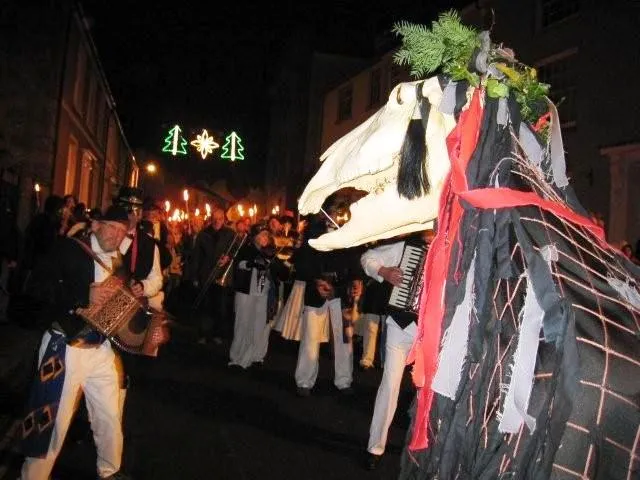
Photo: Unknown, Public domain, via Wikimedia Commons
Winter in the South West can feel like a conspiracy of damp and dark. But look past the early sunsets and you’ll find villages and towns that have turned the coldest months into something stranger, warmer and far more memorable than another night in front of the telly. These are customs built on fire, cider, disguise and neighbourly nonsense — and most are free to watch, join or at least gawp at. Dates vary, so always check locally before you travel, but here’s where to start this winter.
1. Montol Festival, Penzance — 21 December 2026
Penzance marks the winter solstice with masks, lanterns and a spot of Guise dancing. The festival was revived in 2007 but draws on much older Cornish midwinter revels, when disguise and misrule were part of the season. Expect processions, fire, singing and a cheerful disregard for looking sensible. Why go? It’s the solstice as it should be: a bit eerie, very sociable and lit by lanterns rather than fairy lights.
2. Tom Bawcock’s Eve, Mousehole — 23 December 2026
The legend goes that a local fisherman braved a storm to bring food to a starving village. Today the story is marked with stargazy pie — fish heads poking through pastry — and a harbour full of Christmas lights. It is part remembrance, part community supper and part excuse to eat something wonderfully odd. Why go? Because a village turning a fish pie into an act of defiance is exactly the kind of energy we need in midwinter.
3. Guise Dancing, St Ives and west Cornwall — between Christmas and New Year
Guisers — disguised revellers — go door to door with music, costumes and a healthy dose of silliness. The custom has roots in the 18th and 19th centuries, when ordinary people took over the streets in masks and borrowed clothes. Modern versions pop up in pubs, halls and squares across west Cornwall. Why go? There is something liberating about being unrecognisable and mildly ridiculous in public.
4. Mummers’ Plays, Devon and Somerset villages — Boxing Day and early January
Folk plays featuring St George, a Turkish knight and a quack doctor are performed in pubs, village halls and sometimes front rooms. The rhymes are often nonsensical, the swords are wooden and the acting is gloriously amateur. Origins stretch back centuries, though the exact story varies from village to village. Why go? It’s theatre with no fourth wall, no tickets and a fair chance of being recruited into the cast.
5. The Ashen Faggot, Devon and Somerset — Christmas Eve
A bundle of ash branches is burned in a pub hearth, and as the bindings snap, another round is poured. The tradition is tied to warmth, light and good luck for the coming year, and it survives in a handful of West Country pubs. Some versions include singing; all versions include standing near a fire with a drink. Why go? It is a fire ritual with a built-in round system — the best kind of history lesson.
6. Wassailing, Somerset orchards — around 17 January 2027
Apple trees are sung to, toasted with cider and generally made a fuss of in the hope of a good harvest. The old Twelfth Night date of 17 January is still used by some orchards, and the noise is meant to scare off bad spirits. You may be asked to bang a saucepan. Why go? Cider, singing and shouting at trees in the cold — what’s not to like?
7. Plough Monday, Devon and Somerset — 11 January 2027
On the first Monday after Twelfth Night, mummers and ploughboys once paraded a decorated plough and asked for “plough money”. The custom marked the return to work after Christmas, with theatre, cheek and a bit of begging thrown in. Revivals often involve music, costumes and a village hall. Why go? It is a reminder that January does not have to be a cultural wasteland.
8. Nickanan Night, Cornwall — Shrove Tuesday eve, February 2027
A night of licensed mischief before Lent, when children traditionally knocked on doors and ran away. The name is murky in origin, but the spirit is clear: pancakes, pranks and a last gasp of fun before the quiet season. Some towns have revived it with storytelling and community events. Why go? It is a gentler, stranger alternative to the usual February slump.
9. Cornish Hurling, St Ives and St Columb — Shrove Tuesday, February 2027
A silver ball is thrown into the crowd and two sides try to carry it through the streets or across fields. It is fast, physical and not for the faint-hearted. The game has medieval roots and survives in a few Cornish towns with strict local rules. Watch from a sensible distance, and do not wear your best coat. Why go? It may be the most West Country thing you will ever witness.
10. Truro City of Lights — late November 2026
Giant illuminated lanterns made by schools and community groups are paraded through the city in a relatively modern tradition that has become a genuine local ritual. Check the exact 2026 date locally, but expect music, crowds and a lot of glow. Why go? It shows how communities can invent their own magic without waiting for permission.
You don’t need a ticket for most of these. You do need layers, a torch and a willingness to join in. Wrap up, check local listings, and don’t be surprised if a stranger offers you cider and a slice of pie. That is the South West in winter: cold hands, warm welcome.